Every second counts.
That’s unless you’re talking about the Olympics. In that case, every tenth of a second counts.
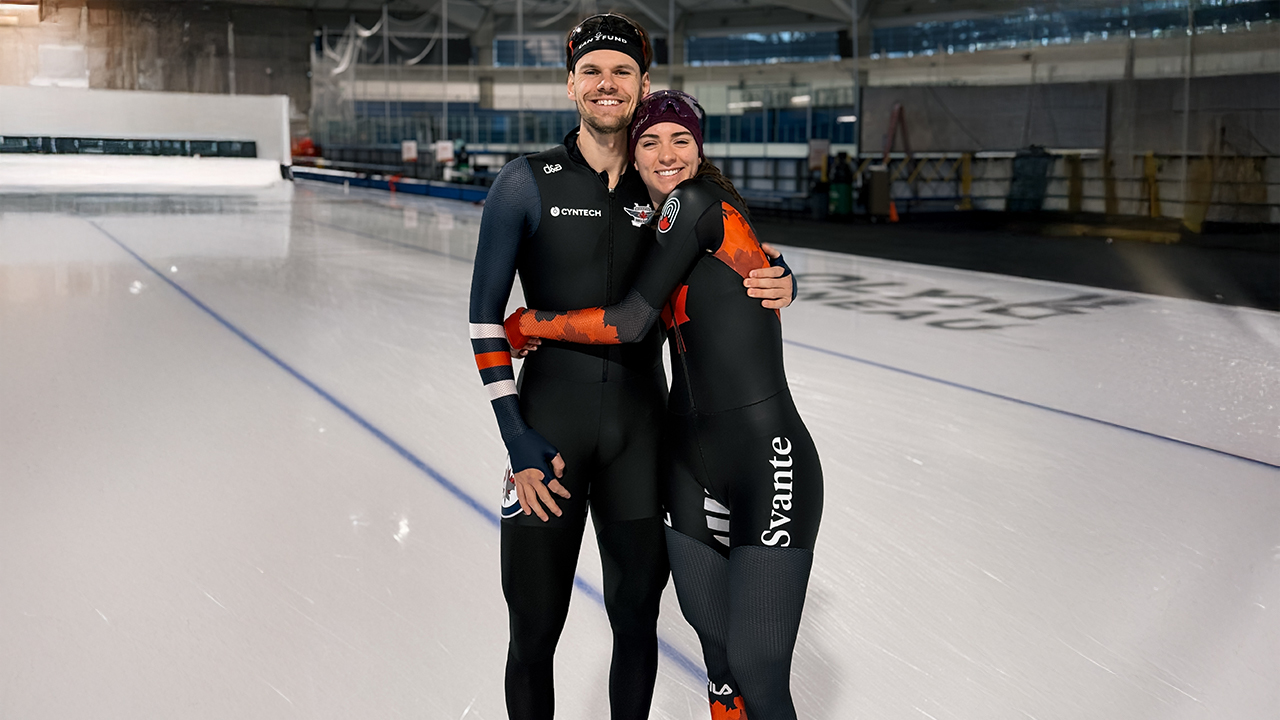
Brooklyn McDougall and Tyson Langelaar know this better than most.
The long track speed-skating couple from Calgary have been laser focused on qualifying for the 2026 Winter Olympics in Milano Cortina for the last few years.
Both competed at the 2022 Olympics in Beijing. Langelaar was part of a men’s team pursuit squad that finished fifth, and he was 22nd in the 1,500-metre event, while McDougall placed 22nd in the 500-metre competition.
The preparation for a return to the Olympics began shortly after they left China. There was the dry-land training, the time on the bikes, the hours in the weight room. There was the time spent studying the technicalities of speed skating and where there’s room for improvement. There was the exploration of mental resilience and refinement of diets to provide optimal results.
And, of course, there were the countless hours on the ice. The days, months and years roll along, hurtling towards the next Olympics.
Ultimately, these years are distilled into much smaller increments of time, something measured in less than the blink of an eye. These are the margins where dreams are realized … or foiled.
CHECK THE SCHEDULE
“Our training schedules have been packed with workouts, trips and meetings. When it’s an Olympic year, you see the training increase because it’s the final year of a four-year build up,” explained Langelaar, who was born and raised in Winnipeg.
“I started training this season at the start of May of 2025 and it ramped up throughout the summer. I started racing and prepping for my bigger competitions in September after a long summer of training. Once October hit, I had Canadian Championships, World Cups and a pre-Olympic training camp. Five weeks of travel in the span of two months definitely adds to the stress of Olympic season.”
There was also the challenge of unstable funding for Langelaar in 2025.
“I lost my National Team status due to injury and some poor performances. This entire season was financially funded by personal sponsors, grants and bursaries. Not having a consistent paycheck made budgeting difficult throughout the season, especially when it came time to buy new equipment, pay for domestic competitions, and traveling to Quebec City for our Olympic Trials.”
Despite the hustle-and-bustle, Langelaar found joy in the approach to the Olympics.
“I enjoyed the process, travel, and the opportunity to race for Canada every weekend away from home,” he said.
McDougall put her own preparation methods into effect for the lead up to Milano Cortina.
“Heading into the Olympics, I maintain my usual routine and focus on my technical goals each day on ice,” she said.
“Although the Olympics is a large spectacle, my race is the exact same as every other race, and I treat is as such. There are more possible distractions, but I have become very good at refocusing and grounding myself in my routine. My usual strategies include listening to music, journaling, and speaking with my sport psychologist.”
THE HOME STRETCH
A spot on Team Canada was determined by the results and rankings from four International Skating Union (ISU) World Cup Speed Skating events held in November and December. If a Canadian skater finished in the top eight of an individual distance following the World Cup competitions, they pre-qualified for that distance at the Olympic Games.
One final shot at the Canadian contingent came through the results at the Olympic Skate-Off, described by Speed Skating Canada as a “last chance qualifier.” That took place in Quebec City in early January.
As the results rolled in, McDougall learned her fate first.
“After all of the women’s races had concluded, I had found out I officially made the team while I was watching in the stands with my parents. It was a very special moment for me to experience that with my family,” recalled McDougall, a University of Calgary grad.
Langelaar had his final race in the men’s 1,500-metre distance about an hour after McDougall learned she had qualified.
“I remember watching and cheering him on right beside the ice. He had an incredible race, and I was already emotional watching him cross the line. As each pair finished after him, I was feeling quite confident that he had qualified,” said McDougall.
Everything seemed to slow down after that. When the final pair crossed the finish line, time stopped.
Langelaar, who placed third in the 1000-metre race, also finished in third in the 1,500-metre … just 0.07 out of second place and a spot on the Canadian Olympic squad.
A human blink typically lasts about 0.1 seconds. In less time than that, Langelaar’s 2026 Olympic dream was over.
“This is just speed skating, where every hundredth counts. Although it stings and it’s still sinking in that I will not be competing in Milan, I look back on my race and struggle to find a spot where I could have gained a tenth. Saying that, I am proud of how I raced under the pressure given the circumstances,” said Langelaar in an emotional post on Instagram.
“I am privileged and grateful to be able to compete for an Olympic spot for Canada. This was just unfortunately not my time.”
SUPPORT SYSTEM
It was a bittersweet moment for the couple, but they supported each other through it.
“I have never been so proud of Tyson for the grit and determination he showed in his race. I was also very proud of how he handled it. He congratulated each competitor and embodied the true Olympic spirit,” said McDougall, one of eight Canadian women to qualify for the long track speed skating team.
“We knew this was a potential outcome – one of us qualifying, and the other not. But I am just very proud of both of us for rising to the occasion and performing under pressure.”
For Langelaar, not making the team didn’t mean he’d miss the Olympics. It just meant a shift in focus.
“I am excited to head to Milan and cheer on Brooklyn and the rest of the talented Canadian athletes competing,” said Langelaar, adding he and McDougall are each other’s number one fans.
“We have a great system. We celebrate our wins and support each other when there are downs. Being in sport together has been surreal and we have seen each other grow as both athletes and individuals. It obviously can be difficult when things on the ice don’t go as planned but we are always supportive and have created a close supportive group to help us while we train towards our goals.”
McDougall will compete in the women’s 500-metre speed skating event on Feb. 15th, and Langelaar will be offering encouragement time after time.