If you had to guess how many world records were broken at the 2026 Milano-Cortina Winter Olympics, what would you say?
Seven? Ten? A dozen?
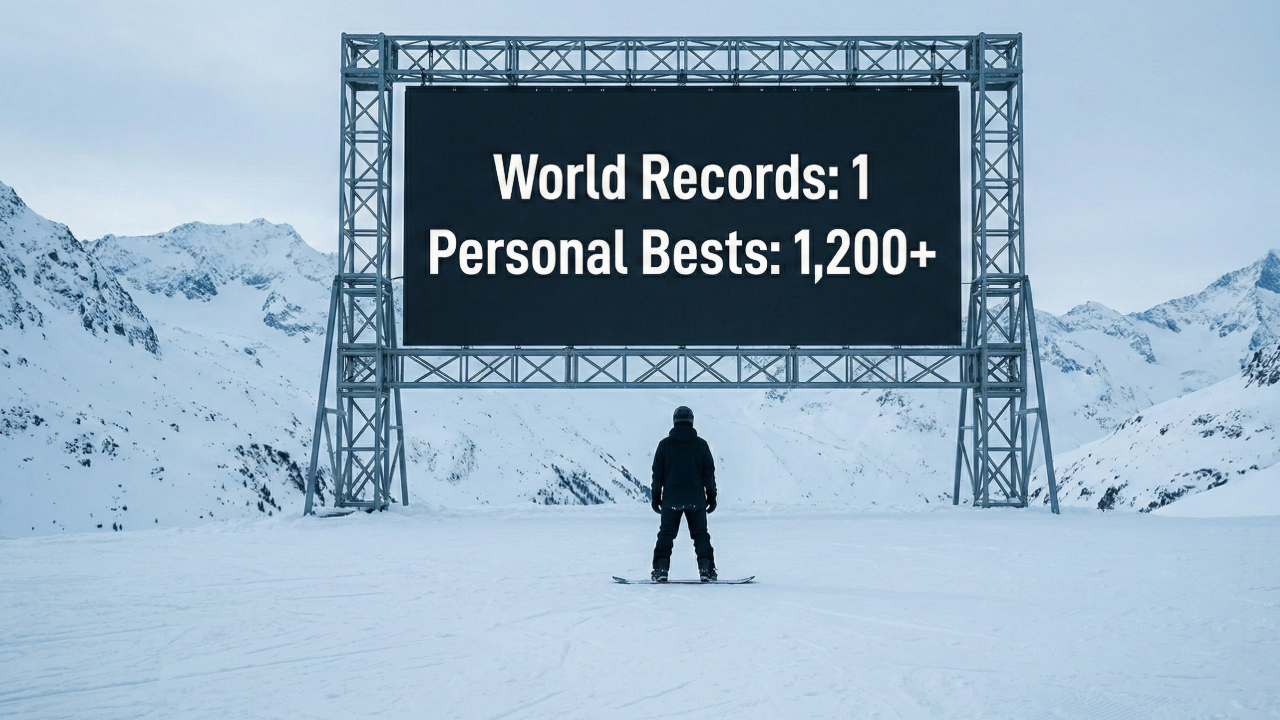
The answer is one.
Across 116 medal events, roughly 2,900 athletes, and a Games schedule that created about 200–300 genuine world-record opportunities…
One world record.
That’s it.
It happened in Short Track Speed Skating, when Xandra Velzeboer reset the global standard in the women’s 500m. Brilliant. Historic. Deserving of headlines.
But here’s what should stop us in our tracks:
While one world record was broken, an estimated 1,200 to 1,500 personal bests were set during those same Games.
One record in the book.
Up to fifteen hundred records rewritten in private.
As a 13-time Guinness World Records holder, I understand why the record book gets all the attention. I’ve lived the headlines, the certificates, the “world’s best” label. But I also know what those moments are actually built on: thousands of personal bests that nobody applauds. Records are the occasional outcome. Personal bests are the daily practice – and I’m still chasing mine.
The Math We Don’t Talk About
Let’s zoom out.
You’ve probably heard this number:
740 medals were awarded at the 2026 Winter Games.
But here’s the catch: that number counts individual medals, including team sports where a single medal event can hand out dozens of medals (think hockey rosters, relays, team events).
A better way to understand medal reality is this:
Only about 12–15% of athletes won at least one medal.
Which means roughly 85–88% of Olympians competed at the Winter Olympics and left without one.
That’s the reality of elite sport.
Most athletes who qualify have no realistic chance of winning gold. Many have no realistic chance of winning any medal at all.
And yet they still go.
Why?
Because medals are limited.
Personal bests aren’t.
The Two Kinds of Olympic Truth
The Winter Olympics operate on two different systems.
There’s the objective world:
The clock.
The finish line.
The measurable.
Speed skating. Short track. Downhill skiing. Biathlon. Faster or not.
Then there’s the interpretive world:
Judges.
Components.
Execution.
Artistry.
Figure skating. Freestyle skiing. Snowboard halfpipe.
In a timed sport, a personal best is clear. You either beat your previous time or you don’t.
In a judged sport, it’s more complex. You might deliver the skate of your life… but whether the score reflects that is partially out of your control.
And yet, in both worlds, the same pursuit exists:
Athletes are chasing their own ceiling.
Not the world’s.
Theirs.
Lightning vs. Electricity
We are wired to celebrate rarity.
But rarity is not the same thing as importance.
World records are lightning strikes.
Personal bests are electricity.
One is spectacular.
The other powers everything.
And the numbers explain why lightning is so rare.
In long-track speed skating, the sport we associate with record-breaking, athletes typically get one race per distance. One shot.
In short track, athletes often get 4–5 races per event (heats, quarters, semis, finals) – 4–5 times more chances.
Even with all those extra opportunities across the Games – 200–300 chances depending on sport formats – only one world record actually fell.
That’s how rare world records have become.
But personal bests?
They’re everywhere.
They are the athlete who moves from 18th in the world to 12th.
The skier who finishes 9th but skis the fastest run of their life.
The speed skater who doesn’t medal but beats their previous time by three tenths of a second.
Those moments don’t trend on social media.
But they are the foundation of greatness.
The Historical Reality Check
If Milano-Cortina 2026 was a one-off, we could shrug and move on.
It isn’t.
When you look at the last eight Winter Games (1998–2026), a pattern shows up fast:
- Nagano 1998: 5 world records
- Salt Lake City 2002: 8 world records (the peak)
- Turin 2006: 0–1 world records
- Vancouver 2010: 2 world records (and sea-level conditions mattered)
- PyeongChang 2018: 3 world records
- Beijing 2022: 2 world records
- Milano-Cortina 2026: 1 world record
So what happened?
Two big spikes explain a lot of the early “record era”:
- The clap skate revolution (1998): equipment innovation created a wave of breakthroughs.
- Salt Lake City’s altitude (2002): thin air + fast ice produced a record storm.
Then the advantage became normal.
Once everyone has the same tech, the edge disappears.
And when conditions aren’t perfectly record-friendly, the numbers shrink.
At the same time, something else has been quietly increasing:
- Medal events grew from 68 (1998) to 116 (2026) – a 71% increase.
- Olympic records rise partly because new events create new “first-ever” Olympic records by default.
- Athlete participation climbed and then plateaued around ~2,900.
In other words:
More events.
More medals.
More opportunity.
But world records? Harder than ever.
Which means the most consistent “progress signal” across Olympics isn’t WRs.
It’s personal bests.
Even the historical estimates show it: when world records are scarce, personal bests still stack up – hundreds at a time, sometimes over a thousand.
The Podium vs. The Process
We remember the podiums.
Gold draped in flags.
Anthems playing.
History declared.
But most Olympians will never stand on that podium. The numbers prove it: 85–88% leave without a medal.
And yet almost every Olympian stands on a starting line believing something is possible.
The process – training sessions, early mornings, failures, refinements – is what makes the Games meaningful.
And in that process, personal bests are the currency.
They’re proof the work is working.
They’re momentum.
For many athletes, the real goal is not to win gold. It is to execute at the highest level they have ever reached.
That is a victory available to everyone.
The Real Record
Here’s the real story of the 2026 Winter Olympics:
- 1 world record
- ~200–300 legitimate world record opportunities across all sports
- Only 12–15% of athletes winning any medal
- 85–88% leaving without one
- Up to 1,500 personal bests
The Games were not defined by a single rewritten world standard.
They were defined by thousands of attempts.
Thousands of starts.
Thousands of risks.
And somewhere between 1,200 and 1,500 times, an athlete did something they had never done before.
That’s the record that matters.
Why This Matters Beyond the Olympics
World records belong to one person at a time.
Personal bests belong to anyone willing to try.
You don’t need Olympic ice.
You don’t need judges.
You don’t need a podium.
What you need is effort.
Courage.
Another attempt.
Most athletes at the Olympics won’t win a medal.
But almost everyone has a chance to leave better than they arrived.
And so do we.
Beyond the record book – beyond the medals and the headlines – the real record is this:
Did you push your ceiling?
Did you give your best effort?
Did you become better than you were yesterday?
Because world records are rare.
Personal bests are happening all the time.
Celebrate both – but don’t ignore the one that’s available to everyone.
About the Numbers
All figures were compiled from official Olympics.com reporting, IOC summaries, sport federation results, and verified coverage. Medal totals distinguish between individual medals distributed versus medal-winning performances, and personal best totals are estimated using PB/SB/NR markers and event participation patterns.